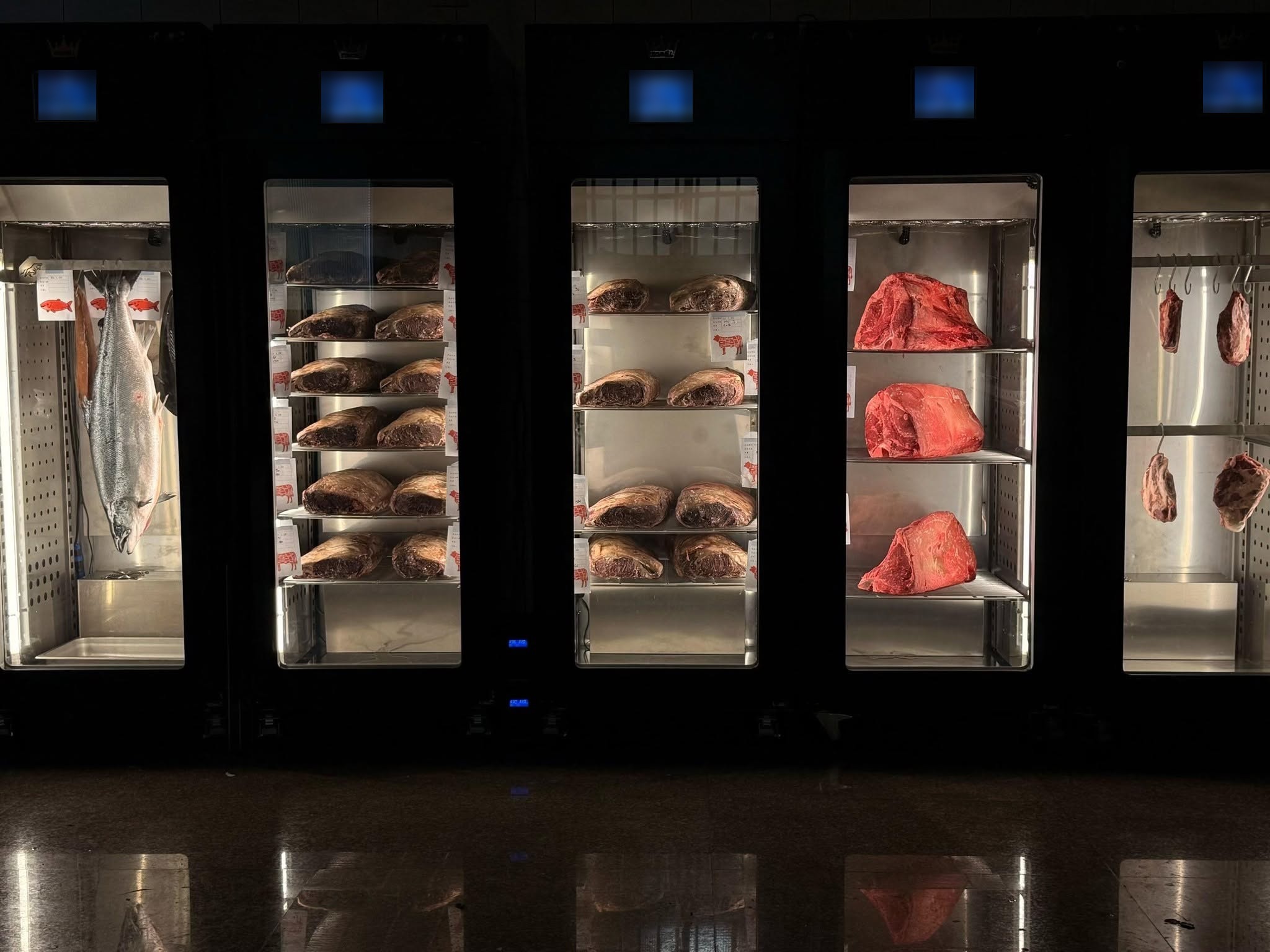
Dry-aged beef has a flavour you can’t fake: deep, nutty, almost buttery, with a tenderness that melts. It looks simple, just let good meat rest in the cold. But behind that simplicity is a surprisingly exact science, and it is why dry-aging has always belonged to specialists.
Three things, held perfectly steady
Dry-aging is not about cold alone. It is three conditions, all held together for weeks:
- Temperature just above freezing, around 1 to 2°C. Cold enough to keep spoilage at bay, but not so cold that the meat’s own natural enzymes, the ones that slowly tenderise it, stop working.
- Humidity around 80 to 85%. Too dry and the meat hardens and shrinks too much; too damp and the surface never forms its protective layer. Get it right and the outside dries into a firm crust while the inside stays moist.
- Gentle, constant airflow. Still air traps moisture in pockets. A soft, even flow keeps every surface consistent from the first day to the last.
Hold all three, steadily, for three to six weeks (around 28 days is the classic sweet spot), and time does the rest: tenderness builds first, then that deep, concentrated flavour.
Why it costs what it costs
Dry-aged meat loses roughly 7 to 12% of its weight in water over the aging, and the firm outer crust is trimmed away before cooking. A dry-aged cut has literally been concentrated: less weight, far more flavour. That is the trade every dry-aging buyer is really paying for.
The part everyone should know: mould
In the right conditions, unwanted mould does not get a foothold. The rule professionals live by: if you can see mould on the outside, treat the piece as compromised and discard it. The goal is to keep the conditions correct so it never appears. Controlled climate is not a luxury here, it is the whole game.
And then there is fish
Aging is not only for beef. Aged fish, done properly, develops a cleaner, deeper flavour and loses that fishy edge. But fish is far less forgiving than beef, and it should never share a cabinet with meat. In much of Asia, where seafood is at the heart of the table, this is an everyday craft rather than a rare one, and it is an area we are especially excited about.
Why an ordinary fridge simply can’t
Look back at that list: a steady 1 to 2°C, 80 to 85% humidity, gentle constant airflow, for weeks. A kitchen or storage fridge holds none of them. It runs warmer, swings every time the door opens, sits bone-dry inside, and moves air at random. It is built to keep things cold, not to hold a climate. That is the difference between refrigeration and true dry-aging.
Coming to Singapore, built for the trade
This is exactly the thinking behind TOROL’s dry-aging cabinet: designed with a butcher-chef’s hands, built to hold that climate steadily, and made for commercial F&B operators who want to age and showcase their product. One focused, professional unit, with local support. It is launching in Singapore soon, with early access opening now.
If dry-aged beef, or aged seafood, is something you are exploring for your business, we’d love to talk.