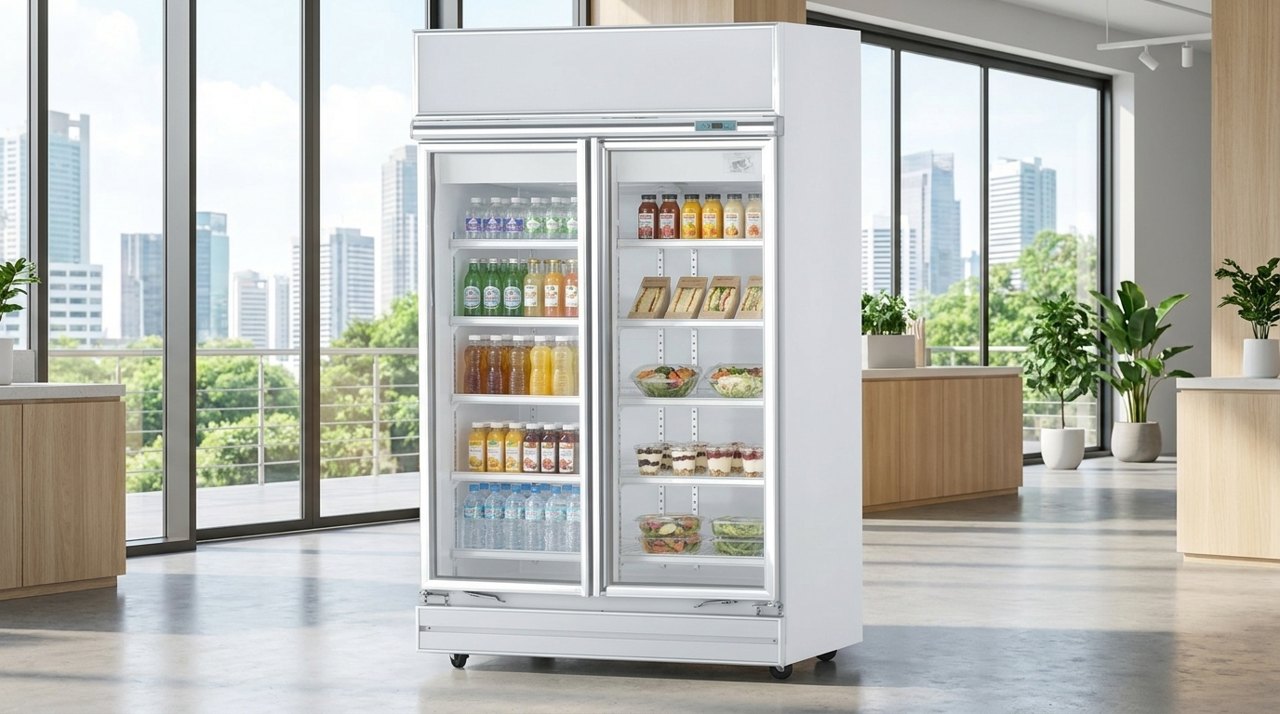
Each time a chiller door opens, food enters the SFA 5°C–60°C danger zone. An ordinary unit can take several minutes to fully recover; a TOROL inverter pulls back far quicker. Across 100 door openings at peak, that gap is hours of cumulative exposure, and the difference between a freshness system and a storage box.
It’s 12:35pm, peak lunch service in a Tanjong Pagar restaurant. Three orders go in, two come back. The sous chef opens the upright chiller, grabs a fillet of fish, slams it shut. Twelve seconds later, opens it again for the prawns. Eight seconds. Open again, beef. Open, sauce. Open, vegetables. By 2pm the door has opened more than 100 times.
Each time, a clock starts. And in most kitchens, that clock runs for 8 to 12 minutes before the fridge fully recovers temperature. That is the number that decides whether your cold chain is real or just on paper.
The 5°C–60°C danger zone is not abstract
Singapore Food Agency officially defines 5°C to 60°C as the danger zone for ready-to-eat food. The reason: between those two temperatures, most foodborne bacteria reproduce at their fastest rate. Some species double their population every 20 minutes. In four hours, one bacterium becomes more than 4,000.
This is why SFA inspectors don’t just want to see a fridge labelled “−18°C” on the door. They want to know how long your food actually spends in that band each day. Every door opening counts.
What “recovery time” really means
When a chiller door opens, three things happen at once:
- Cold air falls out. Cold air is denser than warm air. The moment the door opens, it pours down to the floor like an invisible waterfall.
- Warm humid kitchen air rushes in. In Singapore’s 32°C and 80% humidity, what enters the unit is a wet, heavy load the compressor has to fight.
- The shelf nearest the door spikes. The sensor that controls the compressor may not see it immediately. The middle shelf, with food on it, can warm by 4 to 8°C in seconds.
How fast the unit rebuilds its temperature, that is recovery time. And here’s where the equipment choice shows up.
The maths most operators don’t do
Why inverter changes the maths
A non-inverter compressor is binary, it’s either off, or running at 100%. When the door opens and warm air floods in, it has to wait for the temperature sensor to detect the rise, then start from a cold start, then run at full power until the target is hit. That takes minutes.
3-stage TOROL inverter technology is variable, it modulates its speed continuously based on demand. It’s already running when the door opens. The moment temperature starts to rise, it ramps up smoothly to absorb the load. Plus, the inverter pairs with high-output forced air circulation that pushes cold air directly back across every shelf, not just past the sensor.
That combination is why fast recovery is even physically possible. Without inverter and proper airflow design, it is not.
The honest takeaway
Cold storage is the only system in your kitchen that never sleeps, never goes home, and never gets watched. The gap between a 90-second recovery and a 10-minute recovery is the gap between a freshness system and a storage box. Choose accordingly.
What to ask before you buy
Next time a refrigeration sales rep walks into your shop, don’t ask “how cold does it get?” That is the easy question. Any unit can hit a target on a display.
Ask: “After I open the door for 8 seconds during peak service, how long does it take to fully rebuild temperature in the middle shelf?” If the rep can’t answer in seconds, that is your answer.
Then ask to see the inverter spec. Then ask about the forced-air pattern. Then ask about insulation thickness. Then ask what their warranty actually covers when temperature drift causes spoilage. The conversation gets shorter fast.
Want to know more about TOROL?
Tell us your space and we will recommend an EEG pre-approved TOROL model that fits.