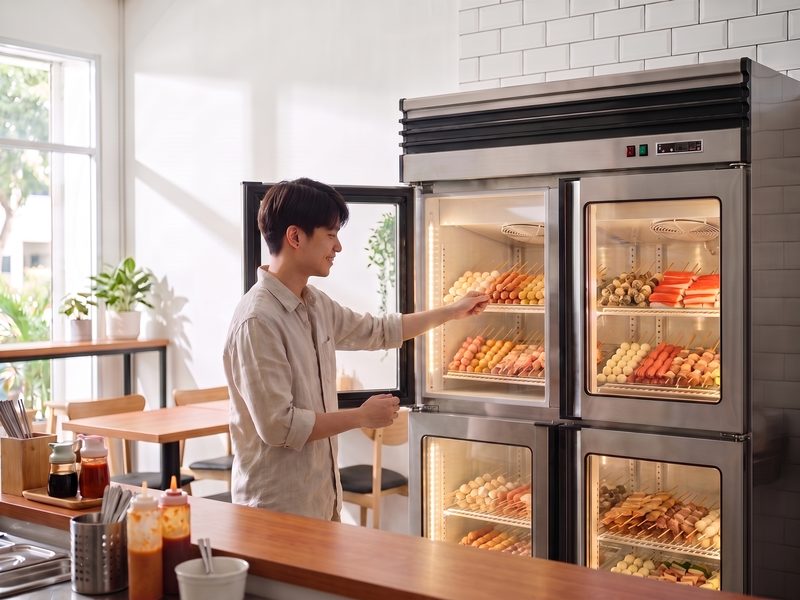
Watch any F&B fridge across a day and one thing stands out: it works hardest exactly when you do, during peak service, which is also when holding a safe temperature matters most.
What happens at peak
During service, the fridge is under pressure from every side at once:
- Doors opening constantly, each one letting warm, humid air in.
- A kitchen that is now hot, cooking heat all around the unit.
- Restocking, as fresh trays of room-temperature ingredients go in.
Pull-down and recovery
Every time the door opens, the temperature inside rises and the fridge has to pull it back down. How fast it does that is its recovery. With openings every few seconds at peak, a fridge that recovers quickly stays in the safe range. One that recovers slowly never catches up, so your food sits warm through the busiest, highest-risk hour of the day.
Why cheaper units fall behind
A basic on/off compressor has one speed: full. It cannot ramp up to meet a rush, so it simply lags. 3-stage TOROL inverter technology modulates, working harder when demand spikes and easing off when it settles. Paired with force-air cooling and good insulation, it holds temperature through the rush instead of chasing it.
Help it through service
Train staff to take everything out in one trip and never prop doors open. Restock during off-peak lulls, not mid-rush. And if your current fridge is visibly warm by 1pm, that is the unit telling you it cannot cope, not a habit you can train away.
A fridge that keeps up with you
Tell us your peak volume and we will recommend a TOROL unit that holds temperature right through the rush.