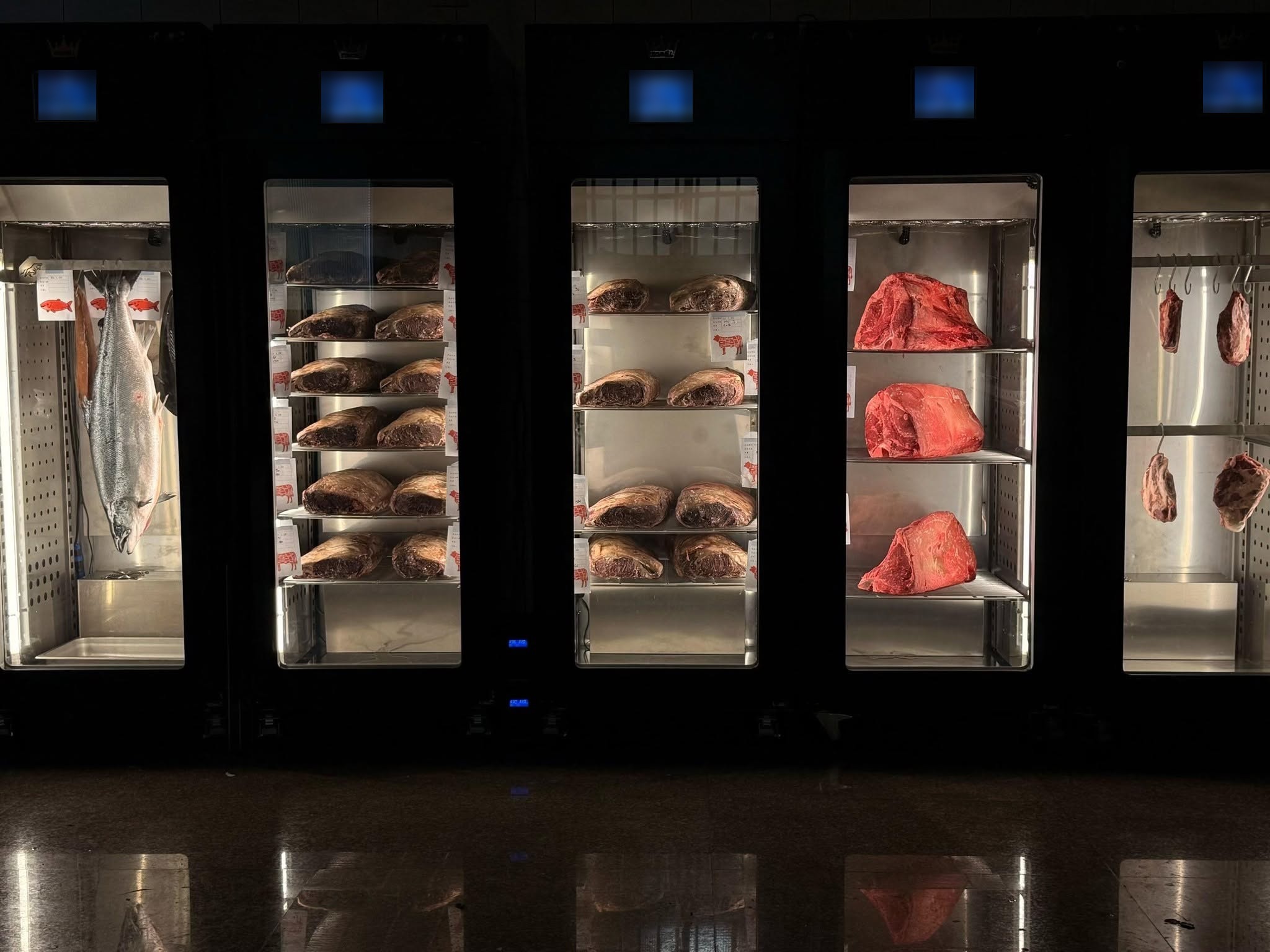
Dry-aging looks simple: hang good meat in a cold cabinet and wait. It is not. The gap between a steak that is genuinely transformed and one that is merely older comes down to a single thing: whether the cabinet can hold its conditions perfectly steady, day after day, for weeks.
That is the part most equipment gets wrong. It is the part we were determined to get right, because our dry-aging unit was not designed by an appliance company. It was designed by our founder, Mr Liang, a working butcher and chef who ages and cooks the meat himself. He built the cabinet he always wished he had.
What proper dry-aging actually does
Over weeks at a steady low temperature, the meat gives up water and concentrates its own fat and flavour, while natural enzymes tenderise it. Done right, the reward is remarkable: deeper, nuttier, more savoury, with a crust that sears like nothing else. Done in a cabinet that cannot hold steady, those same weeks are simply wasted.
No salt wall. None needed.
You may have seen dry-aging cabinets stacked with pink salt blocks. Here is the quiet truth: even the brands that sell those salt walls admit the salt is optional, mostly there to look good, and that a large salt wall can corrode the cabinet over time. A cabinet that truly holds its own conditions does not need a salt crutch. Ours does not. The meat ages in clean, controlled air and tastes of itself.
Beef, and beyond
It is not only steak. A short age transforms fish too, concentrating the flavour and taking away the fishy edge, which makes it as exciting for a sashimi counter as for a steakhouse.
Coming to Singapore: early access is open
We are bringing our dedicated dry-aging unit to Singapore, and we are opening a small early-access list for steakhouses, butcheries and fine-dining operators who want to be first to age on it. Tell us what you would love to age, and we will keep you at the front of the queue.
Want to be first to age on it?
Tell us your space and what you would love to dry-age, and we will be in touch.