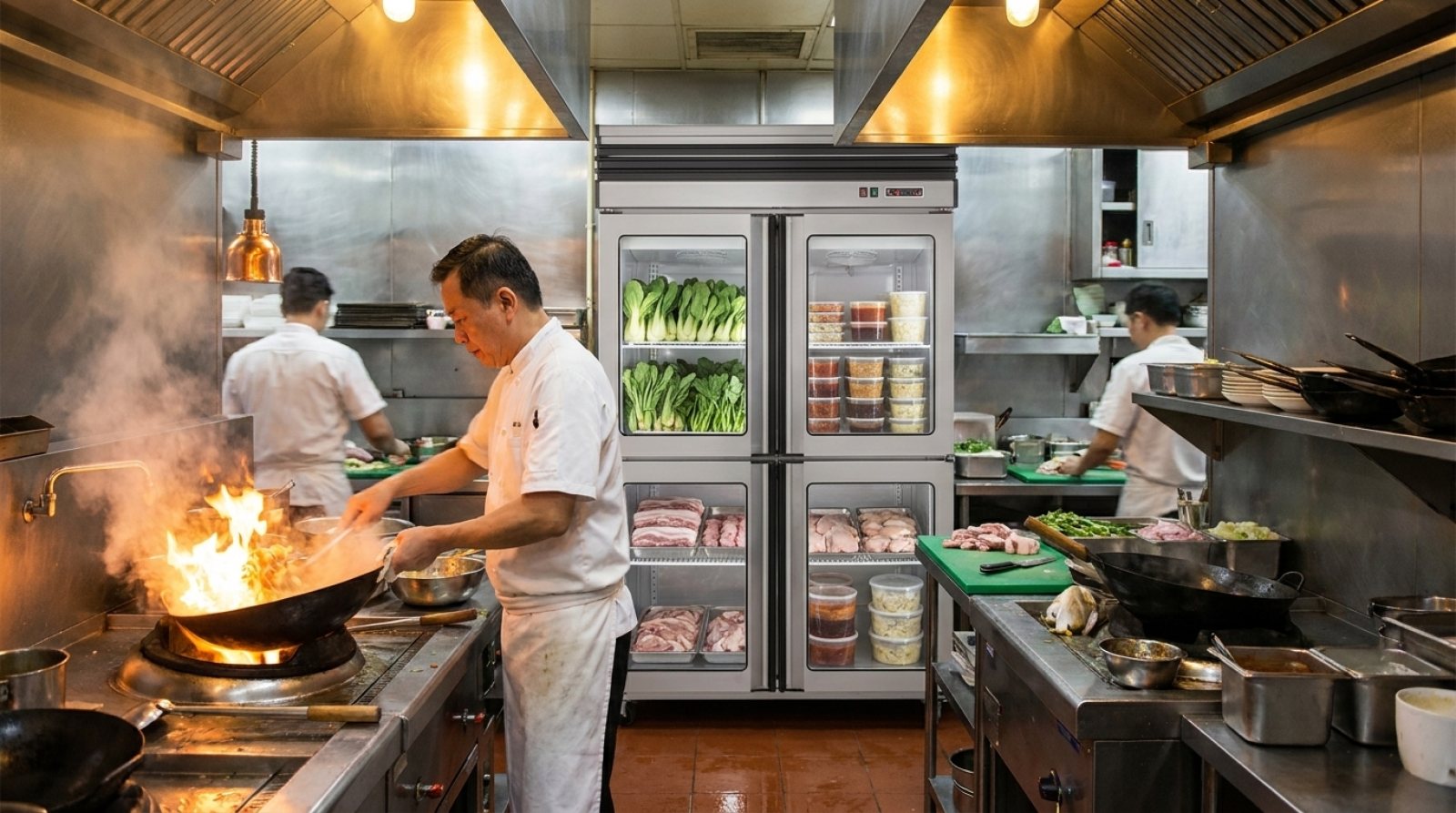
A lot of fridges are sold on the promise that they “kill bacteria.” The honest science says something different, and the difference is exactly what a kitchen serious about food safety needs to understand.
Walk into any commercial-refrigeration showroom in Asia and someone will eventually tell you their fridge “kills bacteria.” It’s a comfortable thing to hear. It’s also not true.
At TOROL we don’t use that line. Here is what the science actually says, and why the honest answer matters more than the convenient one for any kitchen that’s serious about food safety.
Freezing suppresses bacteria. It does not kill them.
Lowering temperature slows bacterial metabolism. Below 5°C, most reproduction stops. At −18°C, the cells are essentially dormant. At −45°C, water inside the cells crystallises rapidly, damaging cell walls and stopping enzyme activity almost completely.
Almost. Not completely. Not actually killed.
Why “suppression” is the honest word
This matters because suppression has a condition attached: it only works while the temperature is held. The moment a poorly insulated unit swings 6°C above its setpoint during peak service, suppression weakens. Bacteria that were dormant become metabolically active again. They consume, they reproduce, and the food quietly degrades, not enough to look spoiled, but enough to make a customer feel unwell three hours later.
So when a brand says “kills bacteria,” the marketing is over-promising and the operator can’t actually rely on it. When a brand says “suppresses bacteria, as long as the temperature holds,” the operator knows what to look for. They look at stability, not the headline number on the display.
The future of commercial cold is smart, not just cold
The industry is moving. Traditional refrigeration was about hitting a temperature target. The next generation is about maintaining it, with stability tight enough to keep suppression intact across the realities of a Singapore peak service, 32°C, 80% humidity, doors opening 100+ times an hour, the compressor fighting back the entire time.
That is the shift TOROL is engineering toward. It’s not a marketing position; it’s the actual product roadmap.
以人為本, human-centric, by design
TOROL Taiwan summarises this position as 以人為本, human-centric. Equipment exists to protect the people who eat the food. Not to hit a marketing temperature number. Not to win a brochure war. To genuinely reduce the risk that someone gets sick from a meal in a kitchen the operator can’t personally watch every second.
That’s a different bar than “hits −18°C on the display.” It’s also the only bar that matters once you’ve served your first thousand covers.
The bottom line
Cold storage is one of the few systems in your kitchen that runs 24 hours a day and never gets your full attention. The honest framing, freezing suppresses, doesn’t kill, and only as long as the temperature holds, is what tells you what to actually look for when you spec the next unit.
Stability over coldness. An active sanitation device over a passive coating. Inverter control over on–off cycling. 304 stainless over paint. Those are the choices that turn a fridge from a storage box into a food-safety system.
Want to know more about TOROL?
Tell us your space and we will recommend an EEG pre-approved TOROL model that fits.